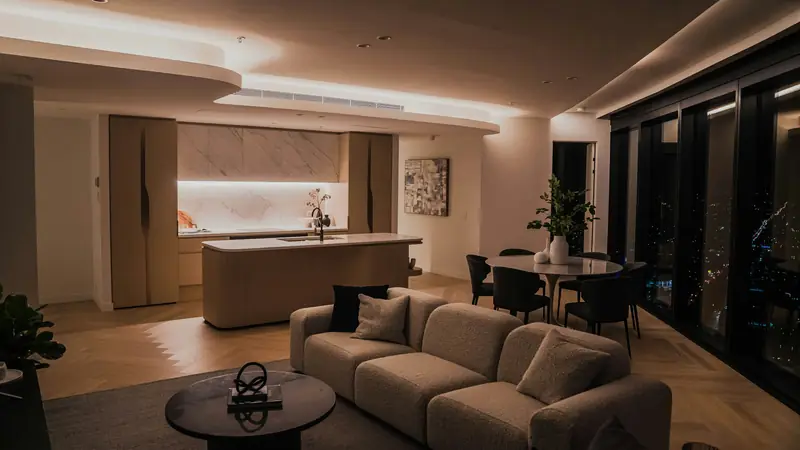
Service charges in Dubai: what they are and how to check them in Mollak
Service charges are the annual community fee every flat owner in Dubai pays. They are charged per square foot, approved by RERA and managed through Mollak. We explain what they cover, why they vary so much between buildings and how to see the exact figure before you make an offer.

What is a service charge, and why does it show up on your first bill?
You close the deal, sign at the Land Department and think you already know what the flat costs. Weeks later a bill arrives that nobody put in front of you: the service charge. It is Dubai's community fee, and it pays to understand it before you make an offer, not after.
A service charge is the annual amount every owner of a home in a jointly owned building or community pays. It covers the maintenance and management of everything shared: concierge, cleaning, security, lifts, the pool, green areas and the cooling of common areas. In Dubai it is calculated per square foot per year, so it depends on the size of the flat and, above all, on the building. The figure is not set by whoever sells it to you: it is approved by the regulator and managed through a public system, so the exact amount for any building can be checked before you buy.
This matters because it is money that recurs every year and directly affects what you keep if you rent the flat out. A flat that is cheap per metre in a tower with endless amenities can be expensive to maintain; one that costs a little more in a plainer building, the other way round. That is why the service charge belongs in the sums alongside the costs of buying: it is part of the cost of being an owner, not an extra you look at last.
Who decides the figure? RERA, Mollak and the end of the developer who used to collect
The fee does not come out of nowhere, and the developer does not set it as they please. Each community submits an annual budget that must be approved by RERA, the real estate regulator within the Dubai Land Department. Without that approval, the management company cannot demand payment, and doing so anyway is a violation.
The money moves through Mollak, the Land Department's system for jointly owned properties. Mollak requires charges to be paid into escrow accounts supervised by RERA, one per community, and it took the developer out of the collection loop: the developer no longer collects, the management company does, under the regulator's control. The stated aim is easy to understand for someone coming from Spain: that your fee is spent on your building and that there is a record of what it went on.
For you, as a buyer, this turns into a practical safeguard. The figure you are quoted has to be approved and registered; if it does not show up in the system, be suspicious.
What are you paying for inside the fee?
A service charge is not a single number: it splits into line items, and understanding the split gives you the criteria to judge whether a fee is reasonable or inflated.
| Item | What it covers |
|---|---|
| General fund | Day to day: security, cleaning, lift and common-area maintenance, cooling of common areas, insurance and building management |
| Reserve fund | Long term: major repairs and equipment replacement (lifts, pumps, façade). Held in a separate account |
| Master community | What is shared across the whole development, not just your tower: roads, parks and services charged by the master developer for the area |
The reserve fund deserves a closer look. It is the one that pays for the big repairs when they come due, and a building with a well-funded reserve spares you surprise special levies later on. A new building usually starts with that fund close to zero, something worth keeping in mind if you buy off-plan.
Why does one building charge three times as much as another?
The same logic that drives the purchase price drives the fee: the area and the type of building. In our own data, the price per metre of a Dubai flat runs from around AED 11,000/m² in the most affordable areas to over AED 30,000/m² on the waterfront (sales registered at the Dubai Land Department between 12 August and 27 October 2026, Calina Real Estate calculation). The service charge follows the same slope: the taller the tower and the more pools, gyms, concierge services and gardens there are to maintain, the higher the fee per square foot.
What moves the figure within that range is concrete: the number and standard of common areas, whether there is centralised cooling of the common areas, the age of the building and how well the community is managed. A flat identical in size can pay a very different fee depending on where it is. That is why the price by area and the fee should be looked at together, not separately.
The only reliable figure for a specific building is the official one, and it is public. You do not need to take an advert's word for it.
How do you check a flat's service charge before buying?
The Land Department publishes a service charge index with the RERA-approved fee for each project, in AED per square foot per year. It is free to check from the Dubai REST app, the same official tool used to check that a flat is legal.
The path is direct: open Dubai REST, go into the service charge index, search for the project, choose the use (residential) and the year, and the approved fee per square foot comes up. Multiply it by the flat's square footage and you have the real annual cost, not the one someone wants to tell you. If an advert's figure does not match the index, that is the conversation to have before signing. When you want us to run that check on a specific flat, book a video call and we will look at it with you.
Off-plan: how much will you pay the day it is handed over?
There is a nuance here that catches many buyers out. In several of the areas where activity is concentrated today (Dubai South, Emaar South, Damac Lagoons or Mudon) almost everything sold is off-plan (sales registered at the Dubai Land Department, same period, Calina Real Estate calculation). And in a building that does not yet exist, the final service charge is an unknown until it comes into operation.
The real budget is set around handover, when the community starts running and RERA approves its first budget. Before that, whatever the developer gives you is an estimate. Add to this that the reserve fund starts almost empty, so in the early years there is less cushion for the unexpected. It is not a problem, but it is something to budget for with room to spare if you buy a new tower or resell it before handover. If you also plan to rent the flat out, the fee eats into part of the income, which is why we put it in the numbers from the start when we talk about rental management.
And if the fee seems unfair or spikes?
You have a way to complain, and it is orderly. The first step is in writing to the community's management company, asking for the breakdown and the justification for the increase. If it does not reply or does not convince you, you can file a formal complaint with RERA through Dubai REST, attaching the letter you sent the management company and its response.
The key is that the fee has to be approved and justified. An increase that does not go through RERA or does not match the registered budget is precisely what that process lets you challenge. It is not common to need to go that far, but it is worth knowing the route exists.
New: three-year fixed fees
The system is moving towards more predictability. In 2025 the Land Department approved, together with the community's management company, the first three-year fixed service fees for the Palm Jumeirah community, with the fee frozen over that period instead of being reviewed each year. Management companies can now process a three-year budget through Mollak, and the annual model remains available.
For an investor it is a good sign: fewer surprises in the fee and an easier job calculating net yield over several years. It remains to be seen how many communities adopt it, but the direction, towards more stable and transparent fees, is the one that suits someone buying to hold, not to speculate.
Frequently asked questions
What are the service charges on a Dubai flat?
Service charges are the annual community fee every owner of a home in a jointly owned building or development in Dubai pays. They cover the maintenance and management of the common areas (security, cleaning, lifts, the pool, gardens, cooling of common areas) plus a reserve fund for major repairs. They are charged per square foot per year, approved by the regulator RERA and managed through the Dubai Land Department's Mollak system.
How do you check the service charge for a specific building?
The approved service charge for each project is public in the Dubai Land Department's service charge index, free to check from the Dubai REST app. You search for the project, choose the use and the year, and the approved fee appears in AED per square foot. Multiplied by the flat's square footage it gives the real annual cost, which can be verified before making an offer rather than relying on an advert.
Who sets and collects service charges in Dubai?
Each community's service charge budget is approved by RERA, the real estate regulator within the Dubai Land Department, and collected by the management company, not the developer. The money is paid into supervised escrow accounts through the Mollak system, one per community. Without RERA's approval, the management company cannot demand payment, so any fee must be approved and registered.
Do you pay service charges on an off-plan flat?
On an off-plan flat the final service charge is not set until close to handover, when the community comes into operation and RERA approves its first budget. Until then, the developer's figure is an estimate, and the reserve fund starts almost empty. It is worth budgeting with room to spare for the first years of a new tower.
What do I do if the service charge seems excessive?
First you complain in writing to the community's management company, asking for the breakdown and the justification. If there is no satisfactory response, you file a formal complaint with RERA through the Dubai REST app, attaching the letter to the management company and its reply. An increase that is not approved by RERA or does not match the registered budget can be challenged through that route.
Sources
For guidance only, reviewed on 10 November 2026. This is not tax or legal advice.